
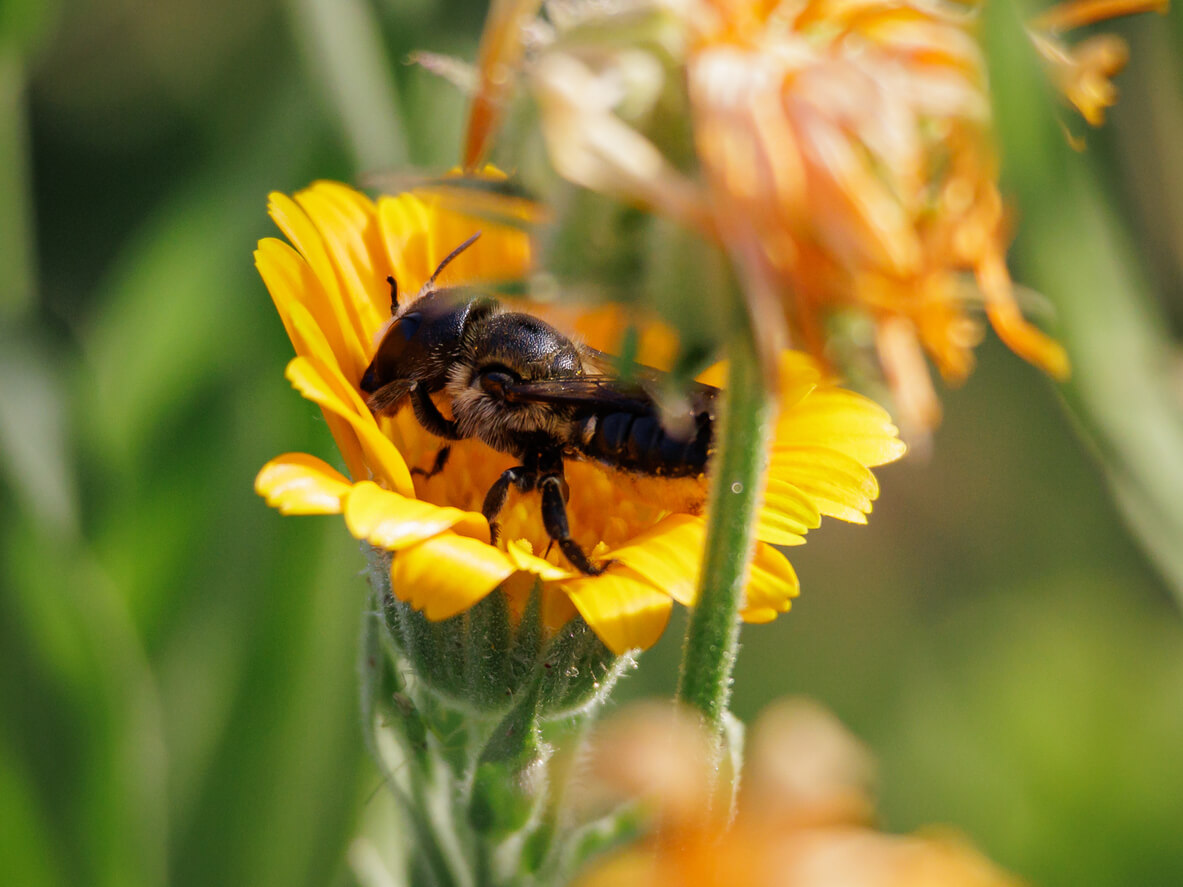
There are many ways to help mason bees and other pollinators in your yard.
You can help mason bees and other pollinators by making your yard more welcoming to them. The native bee Osmia lignaria, commonly called the blue orchard bee or mason bee, is one of the easiest for gardeners to support.
Mason bees are exceptional pollinators. Each bee visits up to 1,800 flowers a day and pollinates 95-99% of them. They fill a special niche in our region because they’re active in early spring, just in time to pollinate fruit trees and berry shrubs. Most other pollinators are not active until the warmer summer months when fruit tree blossoms have faded. As Swansons Nursery says, “Want a better cherry crop? Host some gentle mason bees.”
Meet the mason bee
“Mason bee” refers to bees that build chambered nests in small holes or crevices, using mud they collect from the ground. They can’t create their own tunnels, so they rely on existing cavities, such as dry stems, or ones that gardeners provide. Gentle and nonaggressive, mason bees are easier to keep in urban neighborhoods than honey bees.
If you’d like to welcome mason bees to your yard, now is the perfect time. In western Washington, adult mason bee are usually active from March through May. Many of the steps you take to support them also benefit other pollinators, such as other native bees, butterflies, honeybees and bumblebees.
Basic biology
Mason bees differ from honey bees, bumble bees and wasps in both appearance and behavior. They’re small, solitary bees, and are a metallic, dark blue-green. They don’t form hives like honey bees. but will build individual nests near each other. Mason bees don’t produce honey, and they rarely sting. Males have no stingers at all, while females only sting only if handled roughly or trapped under clothing. The few who have been stung compare it to a mosquito bite. It does not cause anaphylactic shock.
Life cycle
Mason bees have one generation per year. When temperatures reach around 50-55°F in early spring (February through March), adult mason bees chew their way out of their small cocoons and through the mud walls of their chambers. Males emerge first and wait for females, which emerge a few days later. After mating, females find a suitable nesting site and then begin foraging.
The female visits flowers to collect nectar and pollen and brings them into the nesting hole. She shapes a ball of nectar and pollen, lays a single egg and seals it with mud. She repeats this process until there are five to eight egg chambers per nesting hole, then caps the nest with mud. Then she moves to a new nesting hole and repeats this process until the season ends or she dies.
A larva emerges within a few days to a week and feeds on the nectar-pollen ball. After about 10 days, the larva begins spinning a cocoon around itself. It forms a pupa that in the fall transforms into an adult. The adult bee, still in the cocoon, enters a winter dormant state. When spring warmth returns, the adults emerge from dormancy and the cycle begins again.
How to help mason bees and other pollinators
1. Add native plants to your yard
Mason bees and other pollinators depend on flower nectar for food. Choose a variety of plants that bloom at different times of year so pollinators have a steady food source. Mason bees need flowers from late March through May.
Here are 10 Pacific Northwest native plants for pollinators from Swansons Nursery.
- California hazelnut (Corylus cornuta var. californica)
- Vine maple (Acer circinatum)
- Bigleaf maple (Acer macrophyllum)
- Trillium (Trillium sp.)
- Redwood violet (Viola sempervirens)
- Salal (Gaultheria shallon)
- Alpine strawberry (Fragaria vesca)
- Trailing blackberry (Rubus ursinus)
- Oregon grape (Mahonia aquifolium)
- Western buttercup (Ranunculus occidentalis)
And here are links to other useful plant lists.
- Native Plants For Pollinators and Beneficial Insects: Maritime Northwest Region, Xerces Society (pdf)
- Pollinator Plants for Northwest Washington, WSU Extension (pdf)
- 12 plants to entice pollinators to your garden, OSU Extension Service
- Plants for Pollinators: A Regional Guide for Farmers, Land Managers, and Gardeners in the Pacific Lowland Mixed Forest Province, Pollinator Partnership and NAPPC (pdf)
2. Provide clean water and mud
Clean water
Pollinators need water for drinking, cooling and reproduction. Butterflies, for example, will gather and sip at shallow pools, mud puddles or even birdbaths. You may already have a natural water source, such as a pond or stream. If not, you can create a water source. This could be a birdbath, fountain or water garden. It could simply be a hanging water bottle that slowly drips or a small container of water. Place your water source near nesting habitat.
Be sure to change the water two to three times per week, especially during warm weather when mosquitoes are breeding. It’s also helpful to place rocks in your birdbath or small container for insects to land on when they are collecting water. Read more about water sources for pollinators from the Xerces Society.
Mud
Mason bees need a puddle of bare, muddy soil to pack into their nest openings. With climate change, our springs are sometimes not reliably damp, so you may need to provide a reliable source of mud. You can dig up a shovel-full of soil and keep it well watered. Add a drainage hole in your mud container, to keep your mud from being too soupy. Mason bees prefer to use mud that is the consistency of modeling clay for their nests.
Much of our Northwest soil is high in clay, so your yard is probably a good source of mud. If your soil is sandy, you can buy mason bee mud mix from Crown Bees or another source.
3. Reduce or eliminate your use of pesticides
This includes insecticides, fungicides and herbicides. An insecticide called imidacloprid is especially insidious. According to Science, the pesticides “disrupt learning and memory in honey bees and several studies have shown solitary bees suffer the same kind of damage.”
Research done on blue orchard mason bees found that “bees that had consumed [imidacloprid] pesticides had 30% fewer offspring, compared with bees that had grown up without pesticides.” Over two generations, the damage added up. Bees that were exposed to pesticides as larvae and then as adults would have about 75% fewer offspring.
Prevention is the best way
- Grow a healthy lawn. Many of our clients want to go organic but hate lawn weeds. A thick, healthy lawn will resist weeds and moss. Our Bee Friendly Lawn program provides guidelines for how to grow a healthy lawn and help our native bees. We will not use weed and moss killer on lawns that are not maintained properly.
- Keep plants healthy. Choose plants that will thrive in our local conditions, such as native plants and other plants adapted to our climate. Place them in your landscape properly, such as giving them the right amount of sun and shade. Water them properly, and use organic mulch and fertilizer to protect and feed them.
- Monitor pest populations and identify pests. Regularly check your yard for pests to catch problems early. Look for signs of damage, such as chewed leaves or brown spots, and look for insects. Check out this photo gallery of some common pests along with less-toxic approaches to manage them. Here is a pocket guide to common Pacific Northwest pests and more insect and pest resources.
- Use the least-toxic methods to manage pests. Encourage birds and beneficial insects that eat pests. Spray off aphids with water.
- Choose least-toxic pesticides when needed, such as neem oil, insecticidal soap and Bacillus thuringiensis (Bt). You can look up products by brand name in the Grow Smart Grow Safe guide or ask your local garden store for advice.
- Get guidance from the Garden Hotline or a Master Gardener to find an effective, least-toxic solution.
4. Provide nesting habitat
Mason bee houses
In the past we have recommended buying bees from Crown Bees or renting them from Rent Mason Bees. From both firms you can get tubes containing mason bee larvae, nesting tubes or blocks, and a small bee house to hang on a sunny outdoor wall. You can successfully raise mason bees in condos, bee houses and drilled blocks, but it takes effort. You can’t just put up the bee house or block and forget it.
There is increasing concern that raising solitary bees in close quarters creates problems. “Not only do dense bee settlements attract disease, mold and fungus, but those woodpeckers, parasitic wasps and mites also admire them,” said Honey Bee Suite. Many species of birds and rodents will prey upon mason bees, Crown Bees said. The company provides tips for how to use wire mesh or other materials to protect the bee houses.
Problems with parasitic wasps, mites and diseases generally occur when the nesting tubes or blocks are not cared for properly. Both Rent Mason Bees and Crown Bees are taking steps to counteract these problems. Rent Mason Bees does meticulous cleaning when bees are returned to them in the fall. Crown Bees individually inspects and cleans each cocoon. Here are detailed instructions about how to clean cocoons.
Plants with hollow stems
Another way to help mason bees and leafcutter bees is to grow plants with hollow stems. Several characteristics make upright hollow stems great bee housing, according to Honey Bee Suite. The stems are spread further apart, making it more difficult for diseases to spread and for predators, such as birds and wasps, to find the bees. Because they are spread out, it is also more time-consuming for predators to eat them. The stems naturally fall over and start to decompose after a couple of years. Adults will move on to other homes. This keeps pathogen levels low.
Use a variety of stems—both hollow and pithy types are useful for different species. Some bees, such as carpenter bees, like stems with soft, pithy centers. They chew the pith into a paste to use to build partitions between egg chambers.
Year one
-
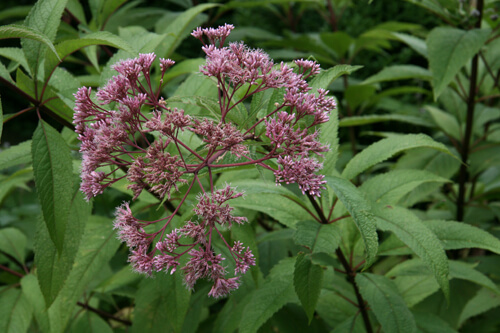
Joe pye weed is a perennial with great color and sturdy stems for bee habitat. © Richie Steffen / Great Plant Picks.
Choose and plant the right plants, such as joe pye weed, sunflowers, lovage, elderberry, teasel, drumstick allium, mountain mint, goldenrod and swamp milkweed. Contact the Garden Hotline or Master Gardeners for advice on appropriate plants for our area.
- At the end of the first growing season, use a sharp tool to make a smooth, clean cut. Honey Bee Suite recommends cutting the stems back to about 12 to 18 inches high, leaving them in the ground. The University of Minnesota Extension recommends cutting stems to about eight inches and tucking them in the crotch of a tree.
Year two
- In spring, bees that are active will nest in the stems you left standing. Leave these stems standing all year. You can also start more plants for the next season. At the end of the growing season, cut back the new, green stems produced this year for next year’s bees to use.
- In the late fall or early winter, some stems may bend over or fall to the ground. Since we have wet winters, you may want to cut the stems at ground level and store them in a cool, dry place.
- Put them out in spring, but use an emergence box so the bees won’t reuse the stems. An emergence box is an empty box with a lid and a small hole where bees can fly out. Bees prefer to lay their eggs in sunny locations. Most will not want to go into the dark box to find their old nesting tube but will use a new hollow stem. Honey Bee Suite has more information about emergence boxes.
Year three
- In spring the bees will emerge from the hollow stems you planted the first year, and many will nest in the stems you planted the second year. “Now you’re on a roll,” said Honey Bee Suite. “You just have to keep going and you should have plenty of healthy bees to pollinate your orchard and garden crops.”
5. Support all pollinators with diverse habitats
Different species need different types of habitat for their shelter and nests.
- Around 70% of native bees are ground-nesting bees. They need access to bare, well-drained soil and may be affected by tilling.
- Around 30% of native bees are cavity nesting, such as leafcutter and mason bees. They need cavities in dead wood, hollow stems or brush piles.
- Plant debris provides homes for overwintering bees and other beneficial insects such as spiders, ladybugs and beetles. This could include fallen leaves, dead plant stems, dried seed pods and faded ornamental grasses.
- Dead wood, such as stumps, snags, logs and piles of twigs or branches, provides nesting habitat for a variety of pollinators such as bees, wasps, beetles and ants.
Read more about nesting and overwintering habitat from the Xerces Society and about creating pollinator habitats from the Washington Department of Fish and Wildlife.
We can help
Our team can help you create and maintain a landscape that supports mason bees and other pollinators. For example, we can design and install a landscape featuring native plants. Our natural lawn, tree and shrub care program will help your garden thrive, without relying on harmful chemicals. Contact us to learn more.
