
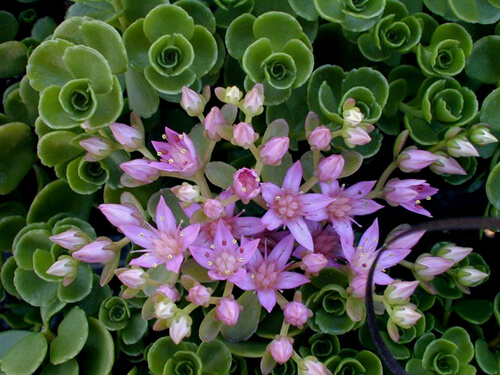
There are many species of stonecrop, such as Sedum spurium ‘Pink Jewel’. They bloom now, in mid- to late summer. © Wayne Fagerlund – www.sedumphotos.net.
We appreciate our native bees, and we hope you do too. They are very effective pollinators, and they play a critical role pollinating wildflowers and other plants, including many of the foods we eat.
Across the United States, there are about 4,000 native bee species. Most are solitary and nest in the ground. They come in nearly every color of the rainbow and range widely in size. In Washington state there are over 600 native bee species. Honeybees are not native to Washington; they were imported from Europe to produce honey. Solitary bees like mason bees and carpenter bees make up 90% of our native bee species. These bees are generally non-aggressive and even stingless, calmly going about their important pollinating work.
You probably know that native bees face serious threats. According to the Center for Biological Diversity, one in four native bee species is at risk of extinction. Threats include habitat loss, climate change, invasive and nonnative species, and especially pesticides. You can help our native bees by providing habitat in your yard.
How to provide habitat for native bees
Plant a variety of plants that bloom at different times during the growing season. Some plants, such as Oregon grape, even bloom in winter. Native plants play a large role, but there are many exotics that do just as well. Look for single flowers with flat faces; fluffy double flowers deter bees.
Plant in swaths. Planting something is better than nothing, but you’ll notice that a single plant rarely has pollinators visiting.
Limit your use of pesticides. This is one of the most important things you can do to help bees and other beneficial insects. Contact the Garden Hotline, your local or Master Gardeners. They can help you determine what is wrong with your plants before treating the problem and give you advice on less-toxic solutions.
Provide shelter and space. Leave a little bare ground. Many native bees are solitary and live in ground nests. And don’t clear away all your dead wood and plant stems; some bees use dead wood or the pith of stems and twigs for shelter and nesting. You can also create human-made nesting sites such as bee-nesting blocks.
Provide a water source, such as an insect watering dish, bird bath or pond.
Read more about creating pollinator habitats.
Top 25 plants for attracting pollinators
Bloom winter through early spring (February through April)
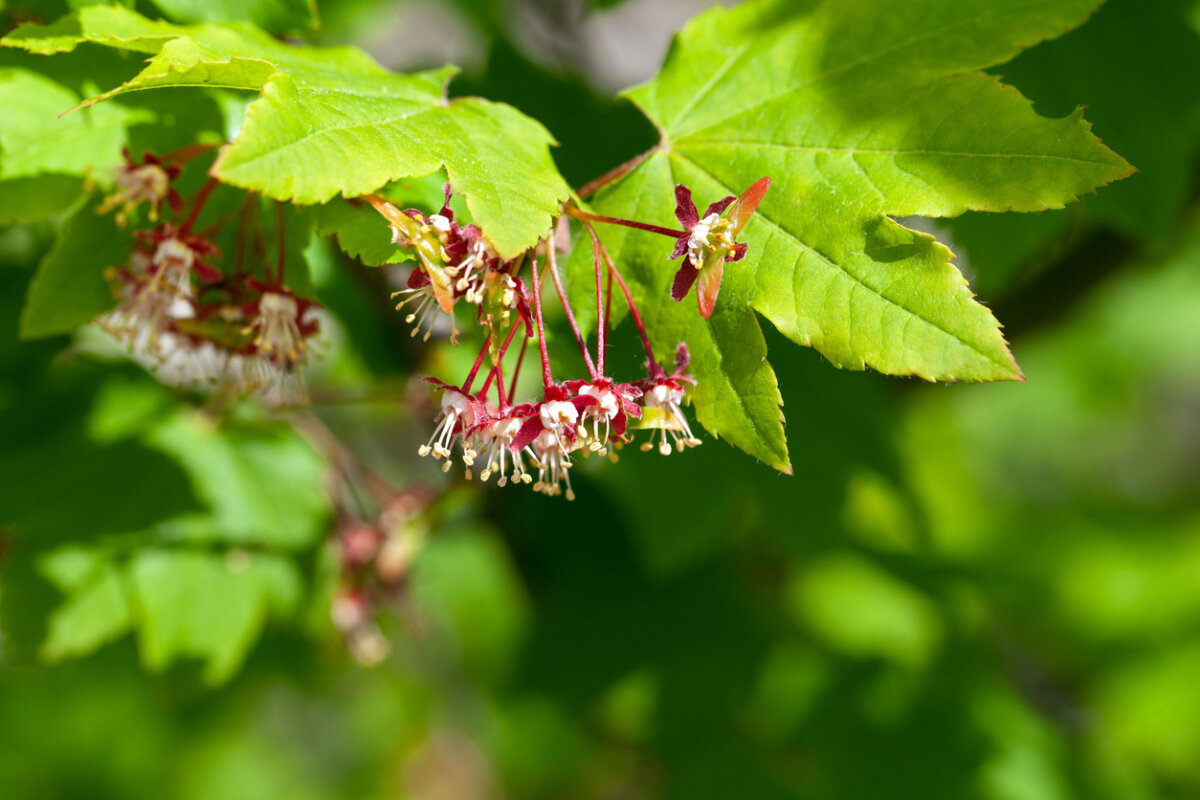
Vine maple, Acer circinatum, is one of the best native trees for the urban garden. It produces small flowers in early spring.
Vine maple (Acer circinatum): Native, deciduous large shrub or small tree that can be trained to a single or multi-trunked form. Good as an understory plant under tall evergreens. Zone 5.
Tall Oregon grape (Berberis aquifolium, formerly Mahonia): The Oregon State flower, this native evergreen shrub busts out with huge can’t-miss-them clusters of yellow flowers. Zone 5.
Camas (Camassia spp.): A native bulb with tall foliage and an even taller stalk of blue flowers. Zone 6.
Crabapple (Malus floribunda): Deciduous tree with masses of pink or white blooms, followed by red berries. Zone 4.
Willow (Salix spp.): Many different types of this deciduous shrub or tree, depending on which you choose. Some have a graceful weeping form. Various zones.
Bloom spring through early summer (April through June)
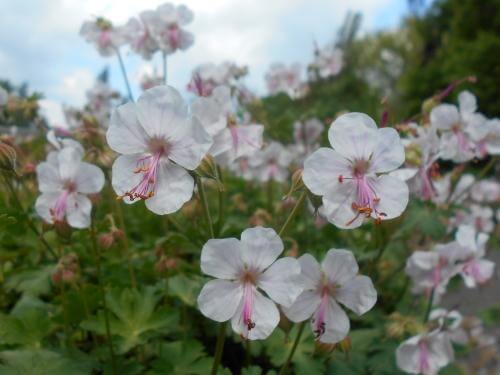
Geranium x cantabrigiense ‘Biokovo’ blooms late spring to early summer. It attracts butterflies, another important pollinator. © Salicyna, CC BY-SA 4.0 via Wikimedia Commons.
Geranium (Geranium spp.): These perennials are not the blustery blooming annual plants that we’re all familiar with; they are tough, hardy perennials with five-petaled flowers in many shades of purple and pink. Various zones.
Western serviceberry (Amelanchier alnifolia): Native deciduous shrub or small tree with star-shaped white flowers followed by maroon-purple berries. Zone 2.
Borage (Borago officinalis): An annual herb with fuzzy foliage and delightful clusters of blue flowers; will reseed year to year. An ancient plant that is used for medicinal purposes.
California lilac (Ceanothus spp.): Tough evergreen shrub with knobs of blue flowers that cover the plant like a blanket. Drought tolerant. There are many cultivars. Zone 6-8.
Tickseed (Coreopsis spp.): An adaptable perennial prized for its bright yellow flowers, often with a red eye, and drought tolerance. Various zones.
Globe gilia (Gilia capitata): A native annual that’s very adaptable to different situations. Sports puffs of lavender flowers. May reseed.
Lupine (Lupinus spp.): Tall spikes of flowers make these perennials, annuals, and biennials distinctive plants in the garden. The most common is blue, but hybrids run the gamut from pink and red, yellow and white and even bi-colors. Various zones.
Western chokecherry (Prunus virginiana var. demissa): A native deciduous shrub or small tree with pendulous white flowers and attractive bark. Zone 4.
Bloom mid- to late summer (July through September)
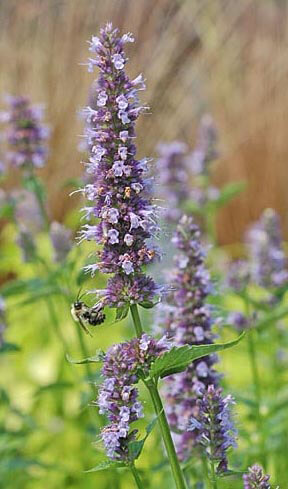
Blackadder hyssop, Agastache ‘Blackadder’, is a favorite of hummingbirds, butterflies and bees throughout the summer and early fall. © Blooming Nursery, Inc.
Blue giant hyssop (Agastache foeniculum and spp.) A drought-tolerant perennial with rods of lavender-blue flowers. Smells like anise when crushed. Zone 4.
California poppy (Eschscholzia californica): The familiar, friendly orange annual wildflower that’s as tough as it comes. Drought tolerant.
Willamette Valley gumweed (Grindelia integrifolia): A native perennial bearing school-bus yellow, daisylike flowers. Great for the beach. Zone 6a.
Showy tarweed (Madia elegans): This yellow-blooming native plant is an annual herb, and a beautiful one at that. Flowers are centered with a red ring.
Catmint (Nepeta x faassenii): A pretty, pest-free perennial with gray-green, fragrant foliage and spikes of small flowers in shades of blue and purple. Zone 4.
Russian sage (Perovskia atriplicifolia): Airy clouds of lavender flowers distinguish this heat-loving, low-water perennial. Zone 4.
Phacelia (Phacelia spp.): A fast-growing annual with fernlike foliage topped with fascinating blue flowers that unfurl in a fiddlehead shape.
Stonecrop (Sedum spp.): There are many species of this succulent, both tall and low. Groundcovers normally put out small yellow flowers; tall have blooms in shades of pink. Drought tolerant. Various zones.
Bloom late summer to fall (September through November)
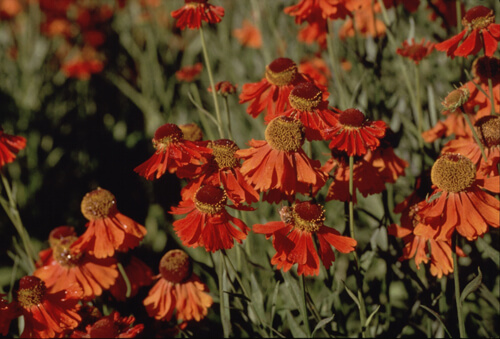
Sneezeweed, Helenium ‘Moerheim Beauty’, blooms abundantly from mid-summer through autumn on bushy plants. © Jim Ledger.
Sneezeweed (Helenium autumnale): Another native, yellow-blooming perennial with daisylike flowers and a big cone in the center. Zone 3.
Michaelmas daisy (Aster amellus): An easy-to-grow perennial with daisylike flowers in various shades of purple and pink. There’s even a white one. Zone 4.
Goldenrod (Solidago canadensis): A native perennial with abundant sprays of sunshine yellow. Zone 3.
Douglas aster (Symphyotrichum subspicatum): An adaptable, very-long blooming native perennial with lavender-blue, daisylike flowers. Zone 6a.
– List compiled by Signe Danler, OSU Horticulture Department
Thank you to OSU Extension Service for the plant list and other information on helping native bees.
Would you like help creating a landscape with a variety of plants that attract native bees? Contact us to find out about our sustainable landscape design and installation services.
