
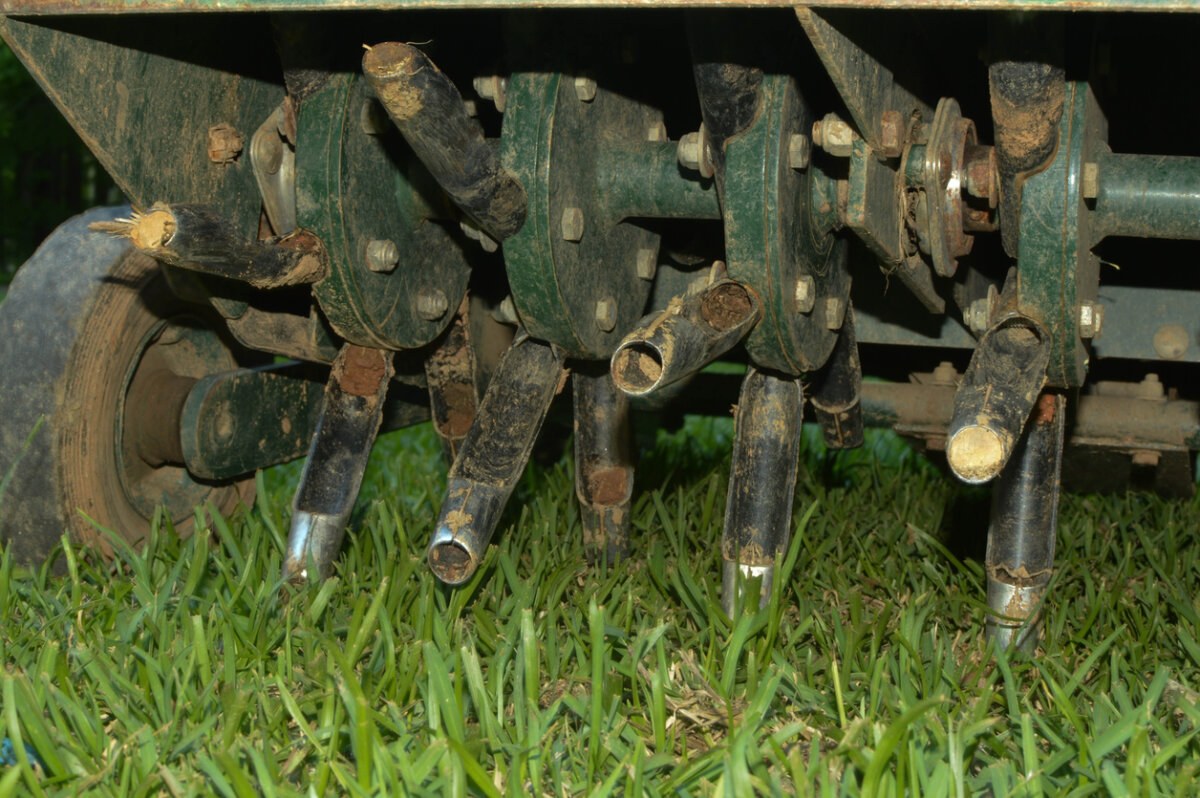
Spring aeration and overseeding will help build your lawn’s health before the stress of summer heat.
Spring is a great time to aerate and overseed your Pacific Northwest lawn. This process creates dense, healthy turf, improving your lawn’s resilience to summer heat stress. There are many benefits of aeration and overseeding.
Relieves soil compaction
Winter rain and foot traffic heavily compact Pacific Northwest clay soils, restricting oxygen to roots. Core aeration pulls up plugs of soil, creating holes in the ground. This breaks up compacted soil, improving drainage and reducing water pooling.
Improves soil health, encourages strong root growth
Aeration allows air, water and nutrients to reach the root zone and fosters healthier soil microorganisms. By creating spaces for air and water, roots can grow deeper and stronger. The grass will be more resilient against drought and summer heat.
Reduces weeds
A thick, dense lawn acts as a natural barrier, crowding out new weeds, while improving the overall health of the grass to fight off diseases and insects.
Reduces moss and thatch
By improving air circulation and soil health, aeration limits moss habitat, and overseeding fills in thin spots where moss could take root. When the aeration cores are removed, they’re deposited on the soil surface. Each core contains millions of microbes. These microbes begin to feed on thatch and surface debris, helping them to break down.
Thickens and strengthens lawn
Aeration creates small pockets where seed can make direct contact with the earth. Overseeding allows you to introduce newer, more resilient grass species that may grow better in Pacific Northwest conditions. Overseeding also thickens the turf, reducing brown spots.
How to determine if your lawn needs aeration
Every lawn should have aeration and overseeding regularly. To find out if your lawn needs aeration soon, take a screwdriver and insert it into your lawn in several locations when the soil is moist. If it can’t be easily inserted, your lawn is likely compacted and would benefit from aeration. Another common sign of compaction is pooling when it rains as the water cannot easily drain into the soil.
Other factors to consider: If your lawn gets heavy use, such as from children and pets running around, it is likely compacted. If your home was recently built or remodeled, the lawn may be compacted from construction traffic. If your lawn was established by sod, the soil may be layered and could be repaired through aeration.
Contact us for help
Send us a message to be added to our schedule for spring aeration and overseeding services. We also offer a complete program of natural lawn care services to enhance your lawn’s health through the year.
Learn more
Watch our video, Natural Lawn Care: Aerating & Topdressing.
